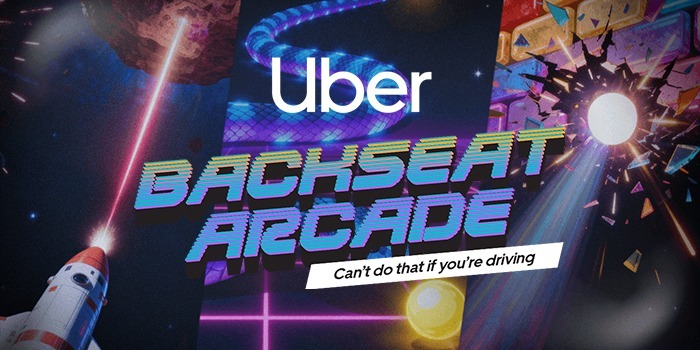
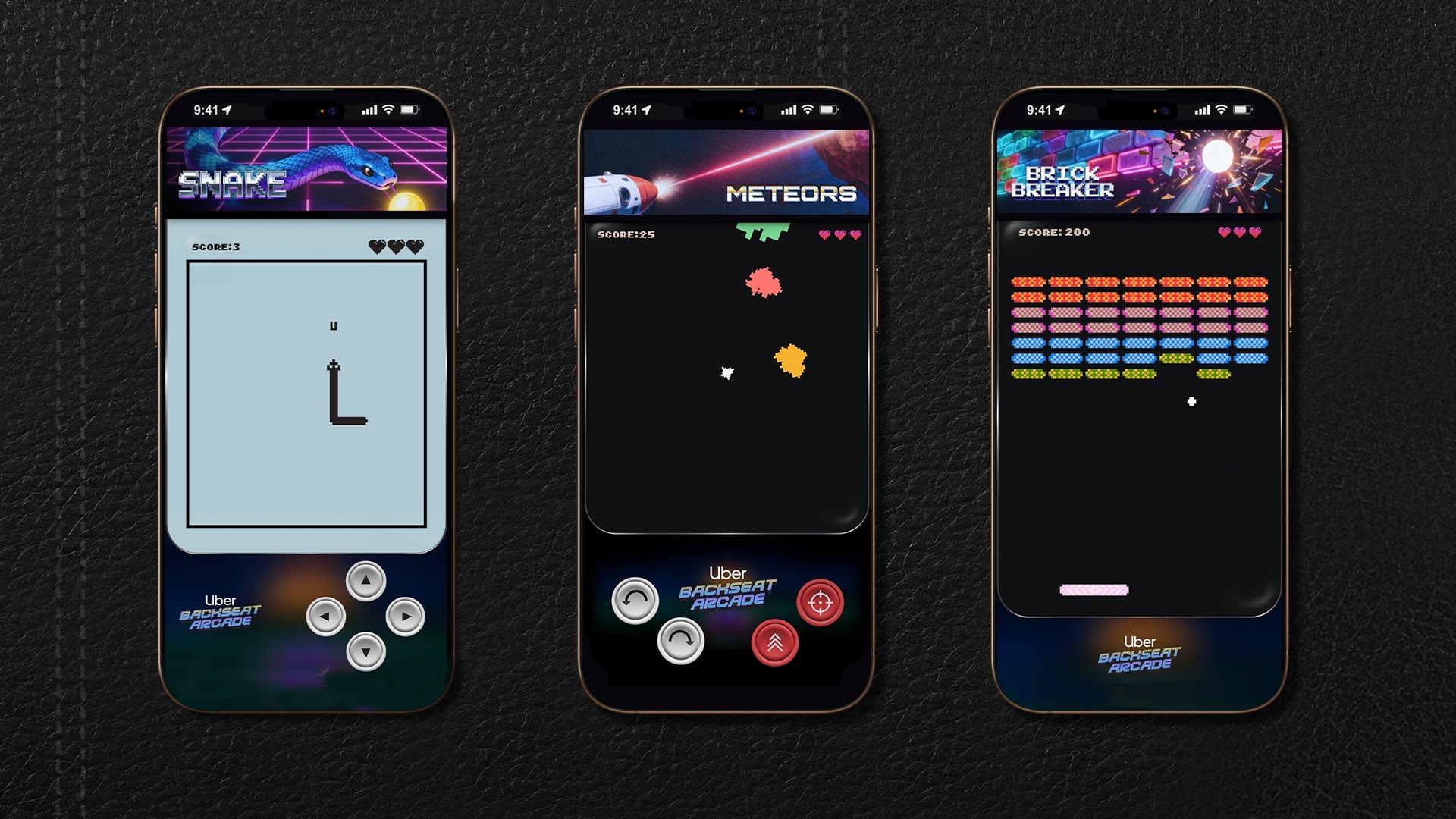
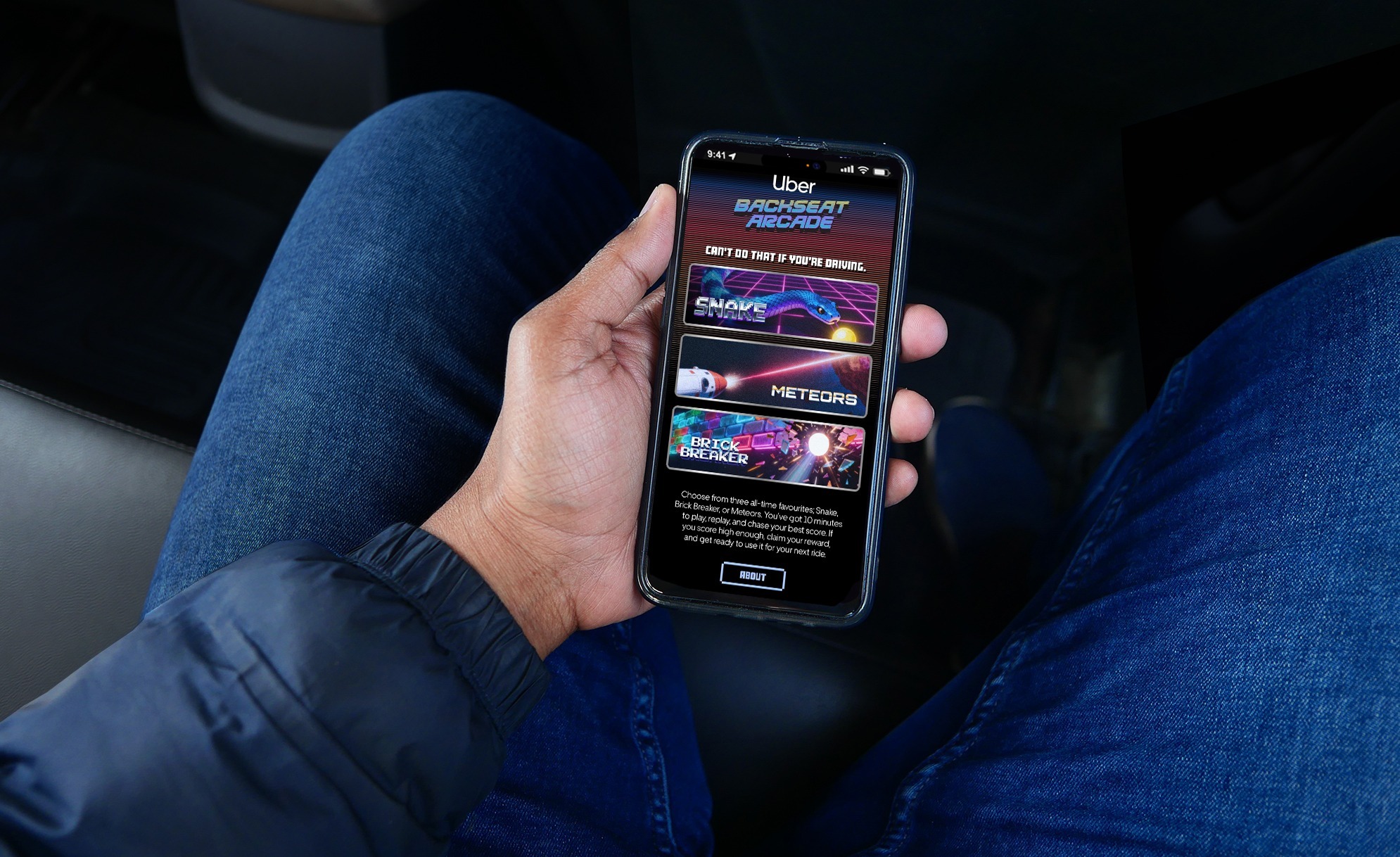
Uber Australia, working with creative agency Special, media partner EssenceMediacom, and gaming specialists Livewire, launched the Uber Backseat Arcade in January 2026, an in-app gaming experience that let passengers play classic retro games (Snake, Meteors, and Brick Breaker) directly inside the Uber app during their ride.
The activation brought Uber’s “Can’t Do That If You’re Driving” brand platform to life in the most literal way possible: turning travel time into playtime, and rewarding riders for choosing Uber with a shot of nostalgia timed perfectly to the average four-minute urban trip.
What made the campaign particularly sharp was its precision in matching format to context. Retro games weren’t a throwaway creative choice, they were deliberately selected for their instant familiarity, zero learning curve, and session lengths that align naturally with short urban trips. A rider doesn’t need to figure out the controls or invest mentally in a storyline. They pick up the phone, tap play, and they’re already halfway through a game of Snake before their stop arrives. That alignment between product experience and campaign message is rarely this clean.
The campaign generated strong industry press and was highlighted as a standout example of technology, creativity, and media strategy converging to create a genuinely memorable brand moment.
Embedding a live, interactive gaming experience inside an app used by millions of Australians demands backend infrastructure that’s fast, fault-tolerant, and capable of scaling unpredictably. Latency issues or downtime during a ride would kill the experience, and reflect directly on the Uber brand.
The constraints here were tighter than a typical campaign activation. Unlike a standalone game app where users tolerate a loading screen or occasional hiccup, this experience sat inside Uber’s existing product, meaning any performance degradation carried brand risk beyond just the gaming moment itself. The infrastructure had to be invisible: fast enough that riders never thought about it, resilient enough that the team didn’t have to either. Add to that the geographic distribution of concurrent sessions across Australian metro areas during peak ride times, and you have a backend problem that demands careful architectural thinking rather than off-the-shelf configuration.
Digital Dilemma designed and deployed the complete AWS infrastructure and server configuration required to power the Backseat Arcade backend, from compute and content delivery to database and monitoring, ensuring a seamless experience for every player, every ride.

Working within a multi-partner delivery structure, our scope was deliberately focused: own the cloud foundation completely, and ensure every other layer of the stack had something dependable to build on. That clarity of ownership mattered in a project with this many moving parts. We coordinated closely with the gaming and app integration teams to establish performance contracts early, latency thresholds, concurrency targets, uptime requirements, then worked backwards from those to make the right infrastructure decisions rather than retrofitting constraints after the fact.
Our role was the cloud foundation that everything else ran on. We handled end-to-end AWS infrastructure setup and server configuration, working closely with the broader project team to ensure the gaming layer had a reliable, scalable backend it could depend on.
Key work streams included environment architecture and provisioning, compute configuration for concurrent session handling, CDN setup for low-latency game delivery across Australian regions, and database infrastructure for leaderboard and rewards tracking. We also implemented monitoring, alerting, and deployment pipelines to give the team confidence going into a high-visibility live launch.
With riders spending approximately four minutes in-app per trip, performance consistency was non-negotiable. There was no tolerance for cold starts, latency spikes, or infrastructure bottlenecks during gameplay.
The result was infrastructure that simply disappeared into the background, which, in this context, is the highest compliment. The Backseat Arcade launched on schedule, handled concurrent sessions across Australian cities without incident, and gave the broader campaign team confidence to focus on promotion rather than firefighting. In high-visibility activations like this, where the go-live window is fixed and the brand exposure is immediate, a stable backend isn’t just a technical deliverable, it’s what makes everything else possible.
Get free consultation and let us know your project idea to turn it into an amazing digital product.
Contact Us